
Citizenship Application Refused UK: A Strategic Legal Guide to Your Options
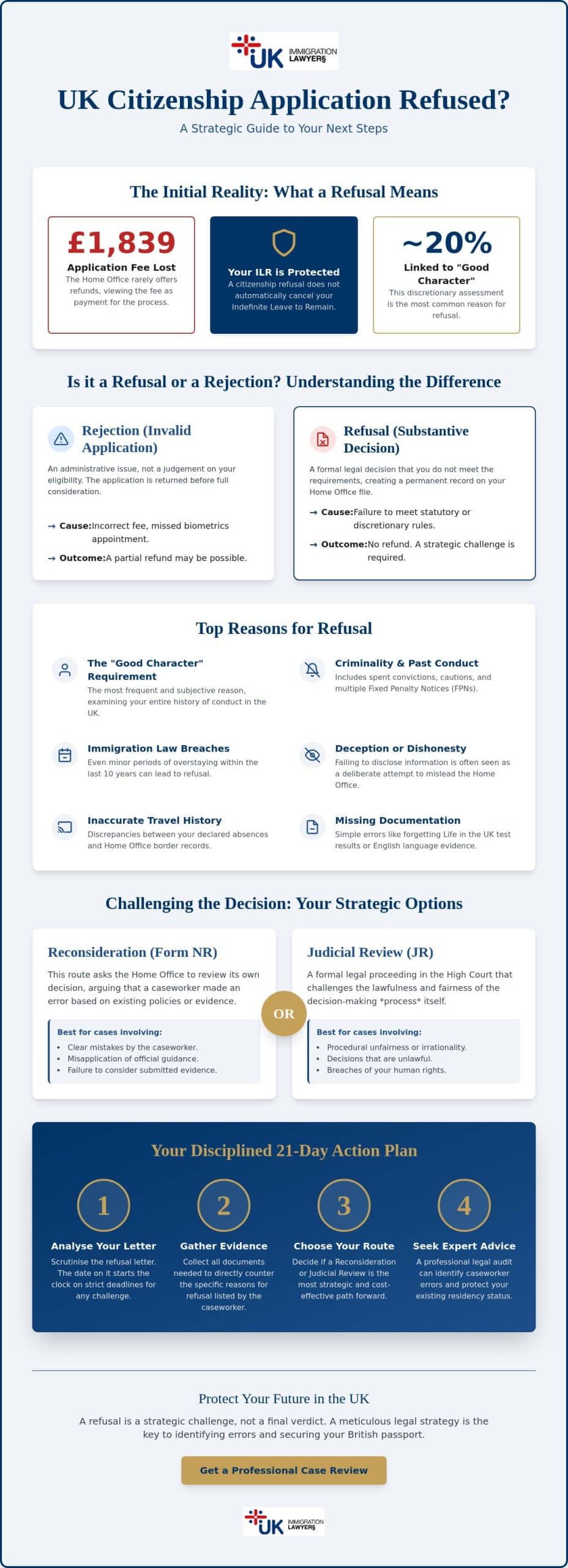
Statistics show that “good character” assessments now account for nearly 20% of all citizenship rejections. If your citizenship application was refused in the UK, you’re likely facing frustration over the lost £1,839 fee. You might also fear for your residency status. We recognise the gravity of this situation. A refusal notice is a strategic challenge to be managed, not a final verdict on your life in Britain. Your Indefinite Leave to Remain remains valid whilst you determine the most effective way to respond.
This guide provides the precise legal pathways required to challenge the Home Office and secure your future. We’ll examine the April 2026 policy updates to identify if the refusal was a caseworking error. You’ll learn how to choose between a Form NR reconsideration and a judicial review. This ensures your next steps are disciplined and cost-effective. Success depends on a meticulous diagnosis of the decision letter before acting. By understanding your options, you can move forward with the cautious confidence needed to secure your British passport.
Key Takeaways
- Distinguish between a technical rejection and a substantive refusal to identify the correct legal route for your specific case.
- Discover how to address “Good Character” concerns and historical conduct issues if your citizenship application was refused in the UK.
- Evaluate the strategic benefits of a Form NR reconsideration versus the high-level procedural challenge of a Judicial Review.
- Implement a disciplined 21-day action plan to analyse your decision letter and secure the evidence required for a successful challenge.
- Understand how a meticulous legal audit can identify caseworker errors whilst ensuring your existing residency status remains protected.
Understanding Why a British Citizenship Application is Refused
A refusal is a formal legal determination that you do not meet the criteria set out in British nationality law. It differs significantly from a simple administrative rejection. When a citizenship application is refused in the UK, the Home Office issues a formal decision letter. This document is the foundation of any future challenge. The date on this letter is critical because it triggers strict deadlines for reconsideration or judicial review. You cannot afford to delay your analysis of this document.
Many applicants lose their £1,839 fee due to “low-hanging fruit” errors. These include missing Life in the UK test results or insufficient English language evidence. The Home Office rarely offers refunds for these mistakes. They view the fee as payment for the consideration process, regardless of the outcome. If your application fails because of a missing document, the financial loss is total. This makes the initial preparation phase the most cost-effective time to seek professional scrutiny.
The Difference Between Refusal and Rejection
A rejection occurs when an application is deemed “invalid.” This usually happens if you fail to pay the correct fee or miss a biometric appointment. In these cases, the application is returned and you may receive a partial refund. A refusal is far more severe. It means a caseworker reviewed your eligibility and decided you failed to meet the requirements. This creates a permanent record on your Home Office file. Whilst a refusal doesn’t automatically cancel your Indefinite Leave to Remain (ILR), it signals that your conduct or history is under scrutiny. If you are unsure of your current standing, you should book a legal consultation to protect your residency.
Top Reasons for Refusal in 2026
Caseworkers distinguish between statutory and discretionary requirements. Statutory rules, like the residency period, are rigid and offer little room for error. Discretionary rules, such as the “good character” requirement, allow for caseworker interpretation. In 2026, we see many refusals linked to the “10-year rule” regarding breaches of immigration law. Even minor periods of overstaying a decade ago can trigger a rejection under current guidance. Inaccurate travel history is another common trap. Discrepancies between your application and Home Office border records often lead to allegations of dishonesty. If your citizenship application was refused in the UK due to travel gaps, you must provide a meticulous evidence trail to counter the decision.
The Good Character Requirement: The Primary Hurdle
The “good character” requirement is the most frequent cause for a citizenship application refused in the UK. Unlike rigid residency rules, this criterion is highly discretionary. The British Nationality Act 1981 doesn’t provide a statutory definition of “good character,” which grants Home Office caseworkers significant latitude. They examine your entire history to determine if you’re a fit and proper person for British citizenship. Even if you’ve lived in the UK for decades, a single historical error can trigger a refusal. Your conduct must be exemplary across all areas of life, from legal compliance to financial responsibility.
Criminality remains a primary focus of this assessment. The Home Office considers all convictions, including those that are “spent” under the Rehabilitation of Offenders Act 1974. If your citizenship application was refused in the UK due to a criminal record, the caseworker likely decided your past behaviour didn’t meet the high threshold required for naturalisation. Deception is equally damaging. Failing to disclose a minor motoring fine or a civil penalty is often interpreted as a deliberate attempt to mislead. This “dishonesty trap” can result in a mandatory 10-year ban on future applications. Meticulous disclosure is the only way to mitigate this risk.
Criminality and Non-Custodial Sentences
Caseworkers scrutinise cautions, reprimands, and fixed penalty notices (FPNs) as indicators of habitual law-breaking. Whilst a single FPN for speeding might not lead to a refusal, multiple notices suggest a pattern of disregard for the law. The “rehabilitation period” for criminal law differs from the “citizenship waiting period” used by the Home Office. You might be legally rehabilitated but still fail the good character test. The current Home Office threshold for serious criminality is defined as any offence that results in a custodial sentence of 12 months or more, or persistent offending that causes serious harm. If you’re concerned about a past conviction, it’s prudent to discuss your case with a legal expert before reapplying.
Financial Probity and HMRC Compliance
Your financial history is a direct reflection of your character. HMRC tax disputes, unpaid Council Tax, and County Court Judgments (CCJs) are common grounds for refusal. Caseworkers look for “financial probity,” meaning they expect you to have managed your affairs responsibly and honestly. Bankruptcy doesn’t cause an automatic refusal, but you must prove it wasn’t the result of reckless or dishonest behaviour. Genuine errors in tax returns can often be mitigated if you’ve already rectified the issue with HMRC. However, a pattern of late payments or deliberate tax avoidance will almost certainly lead to a refusal. Meticulous documentation is the only way to prove your financial integrity to the Home Office.
Challenging the Decision: Reconsideration vs. Judicial Review
If your citizenship application was refused in the UK, you must first understand a harsh reality: there’s no statutory right of appeal to an Immigration Tribunal. This distinguishes naturalisation from most other immigration routes. You cannot ask a judge to simply re-decide your case based on merit. Instead, your options are limited to a “Request for Reconsideration” or a high-level “Judicial Review.” Choosing the wrong path leads to wasted time and further financial loss. You must diagnose the exact nature of the error before committing to a legal strategy.
A strategic pivot is often required. If the refusal was based on a simple mistake you made, such as failing to provide a required document, re-applying from scratch is often the most pragmatic route. Whilst you’ll lose the initial fee, a new application is usually processed faster than a legal challenge. However, if the Home Office made a clear error in law or ignored evidence you provided, a formal challenge is essential. This protects your record and prevents the same error from recurring in a future submission. Success depends on whether the error was procedural or substantive.
Form NR: The Reconsideration Process
A Form NR submission is appropriate when a caseworker has failed to follow their own guidance. As of April 2026, the fee for this request is £513. You must demonstrate that the decision was incorrect based on the facts available at the time, or provide fresh evidence that clarifies a previous misunderstanding. If the Home Office wrongly calculated your absences from the UK, a Form NR allows you to present a corrected timeline. In 2026, response times for these requests typically range from three to six months. Success turns on meticulous cross-referencing of your evidence against the Home Office Caseworker Guidance.
When to Pursue a Judicial Review
Judicial Review is the “nuclear option” for cases involving procedural impropriety or irrationality. It’s not an appeal on the facts but a challenge to the lawfulness of the decision-making process itself. The first step is the Pre-Action Protocol (PAP) letter, which must be initiated within three months of the refusal. This letter serves as a formal warning, often prompting the Home Office to settle and settle the case before it reaches court. If your citizenship application was refused in the UK due to an irrational application of the “good character” rules, this is often the only viable remedy.
The financial stakes are high. Initial court fees are £174, rising to £874 for a final hearing, whilst legal fees often range from £5,000 to £15,000 for complex cases. You must weigh these costs against the value of your future in the United Kingdom. If you’re facing a legally flawed decision, you should seek a professional case audit to determine if litigation is a viable path forward.
Action Plan: What to Do in the First 21 Days
Time is your most valuable resource following a decision notice. Whilst the Home Office doesn’t impose the same 14-day limit found in visa Administrative Reviews, the three-month deadline for Judicial Review necessitates a disciplined response. A citizenship application refused in the UK requires a methodical deconstruction of the decision letter. You must determine if the error was a simple oversight or a fundamental misinterpretation of the law. A proactive 21-day strategy ensures you maintain momentum whilst your evidence is still fresh and your options remain open.
During the first three days, your focus must be on the specific paragraphs of the Home Office Nationality Policy cited in your letter. Days four to seven are dedicated to gathering corroborative evidence that directly addresses those points. By the second week, you should have a professional legal opinion on whether the decision was “lawful but harsh” or “unlawful” and challengeable. The final week of this period is reserved for drafting the formal grounds for reconsideration or the Pre-Action Protocol letter. This structured approach prevents panic and ensures your response is grounded in legal reality.
Diagnosing the Refusal Code
Caseworkers rely on specific “Reason Codes” derived from the British Nationality Act 1981. You must identify if your refusal was “mandatory” or “discretionary.” Mandatory refusals, such as failing to meet the five-year residency requirement, are difficult to challenge unless the caseworker’s math is demonstrably wrong. Discretionary refusals, often linked to “good character,” offer more room for legal intervention. If the caseworker ignored evidence already provided in your initial bundle, this constitutes a procedural error. Identifying these “low-hanging” mistakes early allows for a more cost-effective challenge via Form NR.
Gathering Corrective Evidence
Success in a challenge depends on the quality of your documentation. You should adopt a “Meticulous Expert” approach by indexing every piece of evidence and ensuring it corroborates your witness statement. If the refusal letter mentions vague “character issues” or information from “other government departments,” you must file a Subject Access Request (SAR) immediately. This data reveals exactly what the Home Office is looking at. Preparing a detailed witness statement is also vital. It allows you to explain complex residency gaps or historical financial issues in a way that a standard application form cannot accommodate. If your citizenship application was refused in the UK, you must book an urgent legal review to ensure your corrective evidence meets the required High Court standards.
How UK Immigration Lawyers Protect Your Future
Professional legal intervention serves as a protective shield between you and the rigid Home Office system. When a citizenship application is refused in the UK, the value of a formal “Letter of Representation” cannot be overstated. This document does not merely summarise your history. It frames your case in precise legal terms, referencing specific case law and the British Nationality Act 1981. This ensures the caseworker understands why the previous refusal was flawed. We use these letters to address underlying caseworker biases and to clarify complex facts that standard application forms often obscure. Meticulous preparation at this stage significantly increases the probability of a successful reconsideration.
Managing “Good Character” issues requires a high level of strategic depth and historical analysis. We identify potential triggers for future bans before they become permanent records on your immigration file. If a refusal was based on a misunderstanding of your financial history, we provide the context needed to mitigate these concerns. This disciplined approach prevents a single refusal from becoming a permanent barrier to your future life in Britain. Our objective is to present you as a person of integrity who meets the high standards expected of a British citizen.
Our Meticulous Application Audit
Our audit process involves a line-by-line cross-reference of your refusal against the latest April 2026 Home Office guidance. We look for procedural errors where the caseworker may have overlooked key evidence or misapplied a specific rule. This allows us to identify the “Strategic Pivot.” Sometimes, the most cost-effective and efficient path is to stop a doomed challenge and pivot to a new, perfect application. This strategy ensures your Indefinite Leave to Remain is never jeopardised by a poorly handled or aggressive legal challenge. We prioritise your long-term residency status whilst fighting for your right to naturalise.
Securing Your Path to Naturalisation
Protective advocacy offers the peace of mind needed to navigate a complex and often unforgiving legal landscape. You deserve a seasoned professional who has managed every possible complication and knows how to steer your case toward a positive outcome. Our firm provides the steady, reassuring force required to challenge the Home Office with confidence. To begin your recovery process and protect your future, you should book a specialist citizenship consultation today. A citizenship application refused in the UK is a strategic hurdle, but it is not a final destination. Receiving a refusal today does not mean you cannot become a British citizen tomorrow.
Frequently Asked Questions
Can I stay in the UK if my citizenship is refused?
Yes. A refusal of British citizenship does not automatically affect your existing Indefinite Leave to Remain (ILR) or settled status. You remain a permanent resident whilst you decide whether to challenge the decision or re-apply at a later date.
How much does a citizenship reconsideration cost?
As of April 2026, the Home Office fee for a Request for Reconsideration (Form NR) is £513. This fee is non-refundable, even if the reconsideration is unsuccessful, making it vital to ensure your grounds for challenge are legally sound.
Is there a time limit to challenge a citizenship refusal?
Whilst there is no fixed statutory deadline for a Form NR reconsideration, it is advisable to apply within 3 months. For a Judicial Review, you must initiate the Pre-Action Protocol within 3 months of the date on your refusal letter.
Can I re-apply for citizenship after a refusal?
Yes, you can submit a new application at any time. However, if your application was refused due to “Good Character” issues or deception, you may face a mandatory waiting period of up to 10 years before a new application can be successful.
{
“@context”: “https://schema.org”,
“@type”: “FAQPage”,
“mainEntity”: [
{
“@type”: “Question”,
“name”: “Can I stay in the UK if my citizenship is refused?”,
“acceptedAnswer”: {
“@type”: “Answer”,
“text”: “Yes. A refusal of British citizenship does not automatically affect your existing Indefinite Leave to Remain (ILR) or settled status. You remain a permanent resident whilst you decide whether to challenge the decision or re-apply at a later date.”
}
},
{
“@type”: “Question”,
“name”: “How much does a citizenship reconsideration cost?”,
“acceptedAnswer”: {
“@type”: “Answer”,
“text”: “As of April 2026, the Home Office fee for a Request for Reconsideration (Form NR) is £513. This fee is non-refundable, even if the reconsideration is unsuccessful, making it vital to ensure your grounds for challenge are legally sound.”
}
},
{
“@type”: “Question”,
“name”: “Is there a time limit to challenge a citizenship refusal?”,
“acceptedAnswer”: {
“@type”: “Answer”,
“text”: “Whilst there is no fixed statutory deadline for a Form NR reconsideration, it is advisable to apply within 3 months. For a Judicial Review, you must initiate the Pre-Action Protocol within 3 months of the date on your refusal letter.”
}
},
{
“@type”: “Question”,
“name”: “Can I re-apply for citizenship after a refusal?”,
“acceptedAnswer”: {
“@type”: “Answer”,
“text”: “Yes, you can submit a new application at any time. However, if your application was refused due to “Good Character” issues or deception, you may face a mandatory waiting period of up to 10 years before a new application can be successful.”
}
}
]
}
Securing Your Future in the United Kingdom
A citizenship application refused UK is a significant setback, but it isn’t a final determination of your eligibility. Success depends on a meticulous diagnosis of the refusal grounds. You must choose between a Form NR reconsideration or a Judicial Review. Follow a structured 21-day action plan to ensure no deadlines are missed. This helps identify caseworker errors and protects your residency status whilst you prepare a counter-argument. Professional scrutiny ensures that your “good character” is framed correctly within the legal framework.
Our firm operates under the highest UK legal standards. We provide the protective advocacy required to navigate these complex assessments. Our team possesses specific expertise in high-stakes litigation and Form NR submissions. Every challenge is anchored in the latest Home Office Caseworker Guidance. If you’re ready to address the flaws in your decision letter, you should instruct our specialist citizenship lawyers to challenge your refusal. Expert management transforms a rigid legal system into a navigable path toward your naturalisation. Your journey to becoming a British citizen remains achievable with the right strategic guidance.
Frequently Asked Questions
Can I appeal if my British citizenship application is refused?
There’s no statutory right of appeal to the Immigration Tribunal for naturalisation decisions. If your citizenship application was refused in the UK, your primary legal remedies are a request for reconsideration using Form NR or a Judicial Review in the High Court. These processes focus on identifying procedural errors or legal flaws rather than re-evaluating the merits of the case. Success requires a meticulous demonstration that the Home Office failed to follow its own guidance.
Do I lose my Indefinite Leave to Remain (ILR) if my citizenship is refused?
Your Indefinite Leave to Remain (ILR) remains valid even if your citizenship application is unsuccessful. A refusal of naturalisation doesn’t automatically revoke your settled status or right to work in Britain. However, if the refusal was based on serious deception or criminality, the Home Office may separately review your ILR for potential revocation. In most standard cases, your residency remains protected whilst you prepare a new application or challenge.
How long do I have to wait to re-apply for British citizenship after a refusal?
You can technically re-apply immediately, but the timing depends entirely on the reason for the initial refusal. If the rejection was due to a minor procedural error, a fresh application can be submitted once corrected. However, if a citizenship application was refused in the UK due to “good character” issues or deception, you may be subject to a mandatory 10-year waiting period. A strategic review of the refusal letter is essential to determine the safest re-application date.
Will I get a refund of the Home Office fees if my application is unsuccessful?
The Home Office doesn’t provide a refund of the £1,839 application fee if your request is refused. This payment covers the administrative cost of processing and considering your eligibility. You’ll only receive a refund of the £130 ceremony fee if the application doesn’t reach the grant stage. Because the financial loss is total, ensuring your initial submission is meticulously prepared remains the most cost-effective strategy for naturalisation.
What is the “Good Character” requirement and how can I fix a refusal based on it?
The “Good Character” requirement is a discretionary assessment of your conduct, financial integrity, and legal compliance. To fix a refusal based on these grounds, you must provide robust evidence that counters the caseworker’s interpretation of your history. This might include witness statements, proof of tax compliance, or evidence of rehabilitation for historical offences. Success depends on framing your past behaviour within the specific exceptions allowed by the April 2026 Caseworker Guidance.
Can I still travel whilst my citizenship reconsideration is being processed?
You’re generally permitted to travel abroad whilst a request for reconsideration is being processed. Since you retain your current passport and your Indefinite Leave to Remain status remains valid, your right to enter and exit the UK isn’t restricted by the pending challenge. However, you should ensure you’re available to respond to any urgent Home Office enquiries. If your travel involves long absences, this could potentially complicate future residency assessments.
Is it better to re-apply or request a reconsideration (Form NR)?
Re-applying is often faster and cheaper if the refusal was caused by your own error or missing documentation. Conversely, a Form NR reconsideration is the superior choice if the caseworker ignored evidence or misapplied the law. A strategic audit of the decision letter will reveal which path offers the highest probability of success. If the error is legally fundamental, a challenge protects your permanent record from an incorrect determination.
How much does it cost to challenge a British citizenship refusal?
The cost of challenging a refusal varies based on the chosen legal route. A formal request for reconsideration using Form NR carries a Home Office fee of £513 as of April 2026. If you pursue a Judicial Review, you’ll face court fees of £174 for the application and £874 for a hearing, plus professional legal costs. These expenses should be weighed against the significant cost of submitting an entirely new citizenship application.