
Indefinite Leave to Remain UK: The Definitive Guide to Settlement in 2026
You are in the right place if you are preparing an Indefinite Leave to Remain application and feel worried about absences, evidence, salary, relationship documents, previous mistakes or refusal risk. ILR is not just another visa form. It is the point where temporary permission can become settled status, with no immigration time limit on your stay in the UK.
The Home Office will not grant settlement simply because you have lived in the UK for a long time. You must meet the requirements for your route, prove continuous lawful residence, satisfy validity and suitability checks, and provide evidence that matches the Immigration Rules. A small error may be manageable in some cases, but an early application, unexplained absence issue, missing sponsor evidence or inconsistent history can still cause serious problems.
This page explains how Indefinite Leave to Remain works in 2026, what the Home Office is likely to check, where applicants commonly go wrong, and when legal advice can protect the application before money and time are put at risk.
Key points about Indefinite Leave to Remain in the UK
- ILR gives permission to live, work and study in the UK without a time limit, but it can still be lost in certain circumstances.
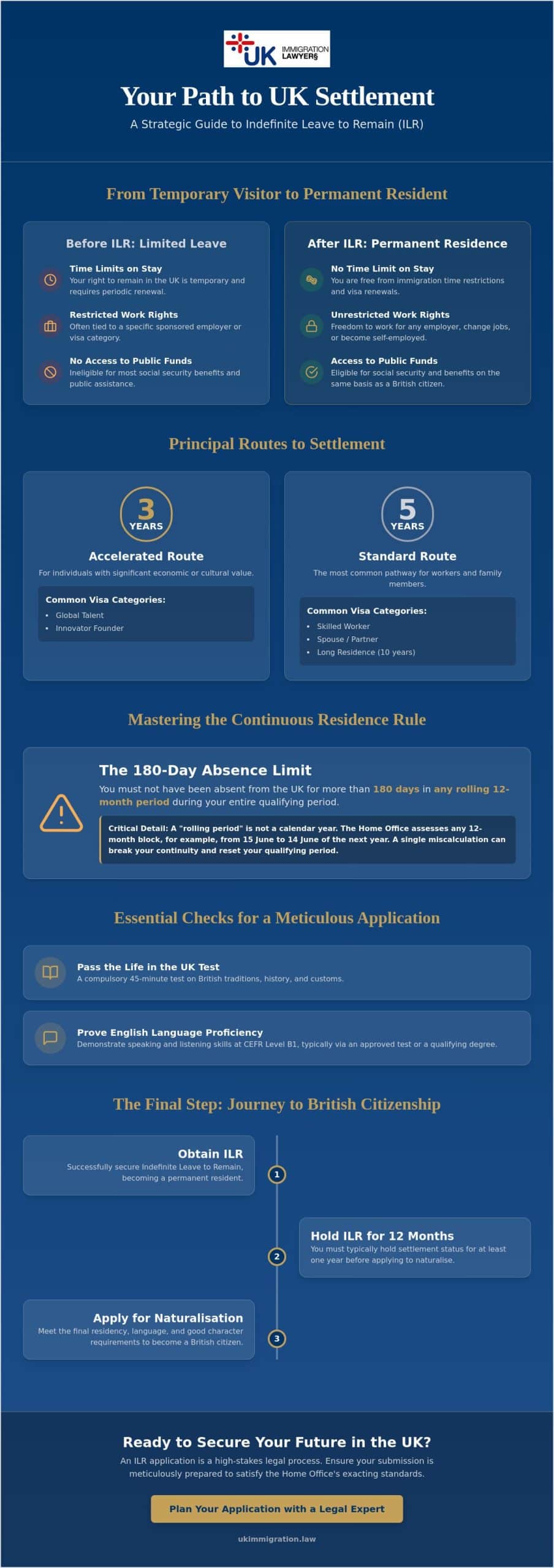
- Most applicants must complete a qualifying period, commonly five years, although some routes are shorter or longer.
- Many routes require no more than 180 days outside the UK in any 12-month period, unless a specific exception applies.
- Long residence has its own rules, including special treatment for absences before 11 April 2024.
- Most applicants aged 18 to 64 must meet the Knowledge of Life in the UK requirement and any relevant English language requirement.
- Fees, salary thresholds and evidential rules can change, so the latest position should be checked before submission.
What is Indefinite Leave to Remain?
Indefinite Leave to Remain, often called ILR or settlement, allows a person to stay in the UK without a time limit. Once ILR is granted, you are normally free to work for any employer, become self-employed, study, run a business and access public funds if you are otherwise eligible.
That freedom is one reason ILR is so important. You no longer need repeated visa extensions. You are usually no longer tied to a sponsor, a specific job code, a partner visa extension cycle or a temporary immigration route. For many people, ILR is also the final step before applying for British citizenship.
ILR is not the same as citizenship. It can lapse after a long absence from the UK, and it can be affected by serious criminality, deception or other suitability issues. A British citizen has the right of abode. A person with ILR has settled immigration permission, but that permission must still be protected.
Digital status and eVisa records
By 2026, most people prove UK immigration status through a digital UKVI account rather than relying on an old physical Biometric Residence Permit. This means your online record matters. Errors in your name, date of birth, passport link, status type or photograph can cause problems with right to work checks, right to rent checks, travel and re-entry.
Before you apply for ILR, it is sensible to review your UKVI account and your immigration history. If your digital status does not reflect your actual grants of leave, the issue should be addressed before it becomes part of a settlement problem.
Who can apply for ILR?
Eligibility depends on your immigration route. Some applicants qualify after five years. Others may qualify after three years, ten years, or through a route with different settlement rules. The correct legal test must be identified before the application is prepared.
Common ILR routes include Skilled Worker, partner or spouse routes, Global Talent, Innovator Founder, UK Ancestry, long residence, private life, bereaved partner, domestic violence settlement and some dependant routes. Each route has its own requirements. It is unsafe to assume that evidence accepted for one route will satisfy another.
The official GOV.UK ILR overview is useful for route checking, but it should not replace a legal assessment where your history is complex: Indefinite Leave to Remain guidance on GOV.UK.
Validity, eligibility and suitability
An ILR application is usually assessed in stages. First, the application must be valid. The correct form must be used, the fee must be paid, biometrics must be provided when required, and the application must usually be made before current permission expires.
Next, the Home Office considers eligibility. This includes the qualifying period, continuous residence, route-specific requirements, knowledge of language and life in the UK, and evidence that the relevant Immigration Rules are met.
Finally, suitability can decide the case even where the residence period is complete. Criminal convictions, immigration breaches, deception, unpaid litigation debt, NHS debt, false documents, tax irregularities or non-disclosure can all create risk. Some issues lead to mandatory refusal. Others require discretion. The facts must be analysed carefully.
Five-year ILR routes
Many applicants apply after five years in a qualifying route. Skilled Worker applicants normally need ongoing sponsorship, a genuine continuing job, a salary that meets the current settlement requirement for the role, and evidence from the employer. The exact salary requirement depends on the occupation code, route history, healthcare or education rules, transitional protection and any applicable going rate.
Partner route applicants must show that the relationship is genuine and subsisting, that accommodation is adequate, and that the financial requirement or relevant alternative test is met. For many partner cases, the minimum income requirement is £29,000. If the applicant first applied before 11 April 2024 and is continuing with the same partner, transitional rules may apply. The correct threshold should be checked before submission.
Global Talent and Innovator Founder applicants may be able to qualify earlier than five years in some circumstances, but the route-specific endorsement, achievement or business requirements must still be met. A grant of earlier settlement should never be assumed without checking the relevant Appendix.
Long residence ILR and the ten-year route
Long residence can help people who have built up ten years of lawful residence in the UK across different immigration categories. This route is often considered by applicants who have moved between student, work, family or other forms of permission.
The rules changed significantly on 11 April 2024. Visitor leave, short-term student permission and seasonal worker permission may be problematic for long residence calculations. Absence rules also require careful treatment. For periods before 11 April 2024, the historic 548-day total absence limit and 184-day single absence limit may still matter. For periods after that date, Appendix Continuous Residence must be applied correctly.
Do not rely on a rough ten-year calculation. One gap, one late application or one wrongly counted period can change the outcome.
Continuous residence and absence rules
Absences are one of the most common reasons people become anxious before an ILR application. In many work and business routes, you must not have spent more than 180 days outside the UK in any 12-month period. This is not simply a calendar year calculation. It can involve a rolling period, depending on the route and the dates involved.
Frequent business travel, remote work abroad, caring responsibilities, illness, bereavement and disrupted travel can all complicate the calculation. The Home Office may compare declared absences with border data. Inconsistencies should be explained rather than ignored.
Some absences may be permitted or disregarded where the Immigration Rules allow it. The answer depends on the route and evidence. Serious illness, travel disruption or compelling circumstances may assist in some cases, but discretion should not be treated as automatic.
What if evidence is weak, missing or inconsistent?
Weak evidence does not always mean the application must fail. It does mean the case needs structure. Missing bank statements, gaps in cohabitation documents, incomplete travel records, old passports, employer errors or inconsistent dates should be identified before submission.
Alternative evidence may be used where it is relevant and reliable. Examples can include HMRC records, P60s, payslips, tenancy documents, council tax records, NHS letters, school letters, travel booking records, employer confirmations and previous Home Office decisions. The evidence must be connected to the legal requirement. Sending a large bundle without explanation can make the case harder to follow.
A legal representation letter can help where there is a genuine problem. It can explain the rule, the facts, the evidence relied on and why the requirement is met. It should not be used to hide weak facts or overstate the case.
Life in the UK and English language requirements
Most settlement applicants aged 18 to 64 must pass the Life in the UK test unless an exemption applies. The test should be taken early enough to allow for a retake if needed. A pass certificate does not expire, but the details must still be available for the application.
Many applicants must also prove English language ability at the required level, usually B1 speaking and listening or above. Some applicants do not need to prove English again because they already met the requirement in their current route. This can apply to certain work routes, including Skilled Worker, but the exemption should be checked carefully.
If you rely on a Secure English Language Test, it must be from a Home Office-approved provider and acceptable for settlement. If you rely on a degree taught in English or a medical exemption, the supporting evidence must meet the Home Office requirements.
ILR fees and priority service in 2026
From 8 April 2026, the Home Office fee for an Indefinite Leave to Remain application is £3,226 per person. Dependants normally pay the same application fee. Fees can change, so the current fee table should be checked before the application is submitted.
Faster decision services may be available for some applications at extra cost, but availability is not guaranteed. A priority service does not make a weak application stronger. It only affects decision speed where the service is available and accepted. You should not use urgent processing to compensate for unresolved evidence problems.
Common ILR refusal risks
- Applying before the permitted early application window.
- Counting the qualifying period from the wrong date.
- Exceeding absence limits without a proper legal explanation.
- Missing employer, salary or sponsorship evidence.
- Using the wrong financial threshold in a partner case.
- Failing to disclose criminal, civil penalty, tax or immigration issues.
- Relying on documents that do not prove the required fact.
- Submitting inconsistent travel, employment or address history.
- Assuming previous visa approval means ILR will be granted.
What happens if ILR is refused?
The correct response depends on the decision. Some ILR refusals may carry administrative review rights. Some may require a fresh application. Some may involve human rights appeal rights. In other cases, judicial review may need to be considered if there is an arguable public law error.
The refusal notice is critical. It should be read in full, including the deadline, the reasons for refusal and whether current leave continues. You should not assume that every refusal can be fixed by sending more documents. Administrative review is usually focused on caseworking error, not a complete re-arguing of the application with new evidence.
Where a mistake has been made, speed matters. A late or poorly chosen challenge can make the immigration position worse.
Can ILR be lost after it is granted?
Yes. ILR can lapse if you remain outside the UK, Ireland, the Channel Islands and the Isle of Man for too long. Standard ILR normally lapses after an absence of 2 or more years. Settled status under the EU Settlement Scheme normally lapses after 5 or more years, or 4 or more years for Swiss citizens and relevant family members.
ILR may also be affected by deportation, exclusion, deception or serious suitability issues. If your ILR has lapsed because of absence, you may need to consider a returning resident application before travelling to the UK.
Does ILR lead to British citizenship?
ILR does not automatically become British citizenship. Naturalisation is a separate application. You must meet residence, absence, good character, English language and Life in the UK requirements.
Many applicants must hold ILR for at least 12 months before applying for naturalisation. Spouses and civil partners of British citizens may be able to apply without waiting 12 months, provided the other requirements are met.
Citizenship residence rules are not identical to ILR rules. For example, the requirement to have been physically present in the UK exactly three or five years before the date of application can cause unexpected refusals. The naturalisation date should be planned carefully.
How legal advice can strengthen an ILR application
Legal advice is most valuable before the application is submitted. A proper review can identify the route, eligibility date, absence position, salary or financial requirement, suitability risks and evidential gaps. It can also prevent unnecessary disclosure mistakes and explain complex facts in a legally disciplined way.
We can help you check whether you qualify, organise your evidence, prepare legal representations and address issues such as long absences, previous overstaying, refused applications, tax concerns, weak cohabitation documents or sponsor problems. Advice does not guarantee success, but it can reduce avoidable risk.
Practical next steps before you apply
- Confirm the correct ILR route and the exact qualifying period.
- Check your current permission expiry date and earliest safe application date.
- Audit every absence from the UK against passports, bookings and travel records.
- Check whether English language and Life in the UK requirements apply.
- Review salary, sponsor, relationship, financial or residence evidence for your route.
- Identify any criminal, civil, immigration, tax, NHS debt or disclosure issues.
- Prepare a clear document bundle and legal explanation where the facts are not straightforward.
Frequently Asked Questions
Can my Indefinite Leave to Remain be lost if I stay outside the UK too long?
Yes. Indefinite Leave to Remain can lapse if you stay outside the UK, Ireland, the Channel Islands and the Isle of Man for 2 or more years at a time. If you hold settled status under the EU Settlement Scheme, the period is usually 5 or more years, or 4 or more years if you are a Swiss citizen or relevant family member. If your ILR has lapsed, you may need to consider a returning resident application before travelling to the UK.
Do I need to retake the English language test for ILR if I did it for my initial visa?
It depends on your immigration route, the level of English you previously proved and whether you are exempt. Most settlement applicants aged 18 or over must show knowledge of English at the required level, usually B1 or above, unless an exemption applies. Some applicants may not need to prove English again if they already met the correct requirement in a previous successful application. If you rely on a SELT, it must be from an approved provider and acceptable for your application.
What happens if my ILR application is refused by the Home Office?
Your options depend on the route, the reason for refusal and the type of decision made. Some refusals may carry an administrative review right. Others may require a fresh application, a human rights appeal, or judicial review if there is an arguable legal error. You should read the refusal notice carefully and take advice quickly, because deadlines can be short.
Can I apply for ILR early if I have lived in the UK for almost 5 years?
In many 5-year settlement routes, you can apply up to 28 days before you complete the qualifying period. Applying too early can lead to refusal, so your eligibility date should be checked carefully against your visa route, date of entry, date of grant and absences from the UK. The exact calculation can depend on your immigration history.
Is the Life in the UK test required for everyone applying for settlement?
No. The Life in the UK test is required for many settlement applicants, but not everyone. Applicants under 18 or aged 65 or over are usually exempt. A person may also be exempt if they have a long-term physical or mental condition that prevents them from meeting the requirement, but suitable medical evidence will be needed. The exemption should be checked before the application is submitted.
How much does the Indefinite Leave to Remain application cost in 2026?
From 8 April 2026, the Home Office fee for an Indefinite Leave to Remain application is £3,226 per person. GOV.UK currently states that biometric information must be provided but there is no separate fee for this in standard ILR applications. Optional faster decision services may cost extra where available, and fees can change, so the current GOV.UK fee page should be checked before applying.
Can I work for any employer once I have been granted ILR?
Yes. Once ILR is granted, you are no longer tied to a sponsor, occupation code or sponsored salary threshold. You can usually work for any employer, become self-employed, run a business, study or stop working. You must still comply with general UK law and any professional or regulatory rules that apply to your work.
Does ILR automatically lead to British citizenship?
No. ILR does not automatically become British citizenship. Naturalisation is a separate application with its own residence, absence, good character, English language and Life in the UK requirements. Many applicants must hold ILR for at least 12 months before applying, although spouses and civil partners of British citizens may be able to apply without waiting 12 months if they meet the other requirements.
Important disclaimer
This page provides general information about Indefinite Leave to Remain in the UK. It is not legal advice on your specific facts. ILR rules, fees, Home Office guidance and evidential requirements can change. Your eligibility depends on your immigration history, route, absences, documents and suitability position.
Last legally reviewed: 28 June 2026
By: Adam Sierant