
Applying for Indefinite Leave to Remain After 5 Years: The Complete Legal Guide
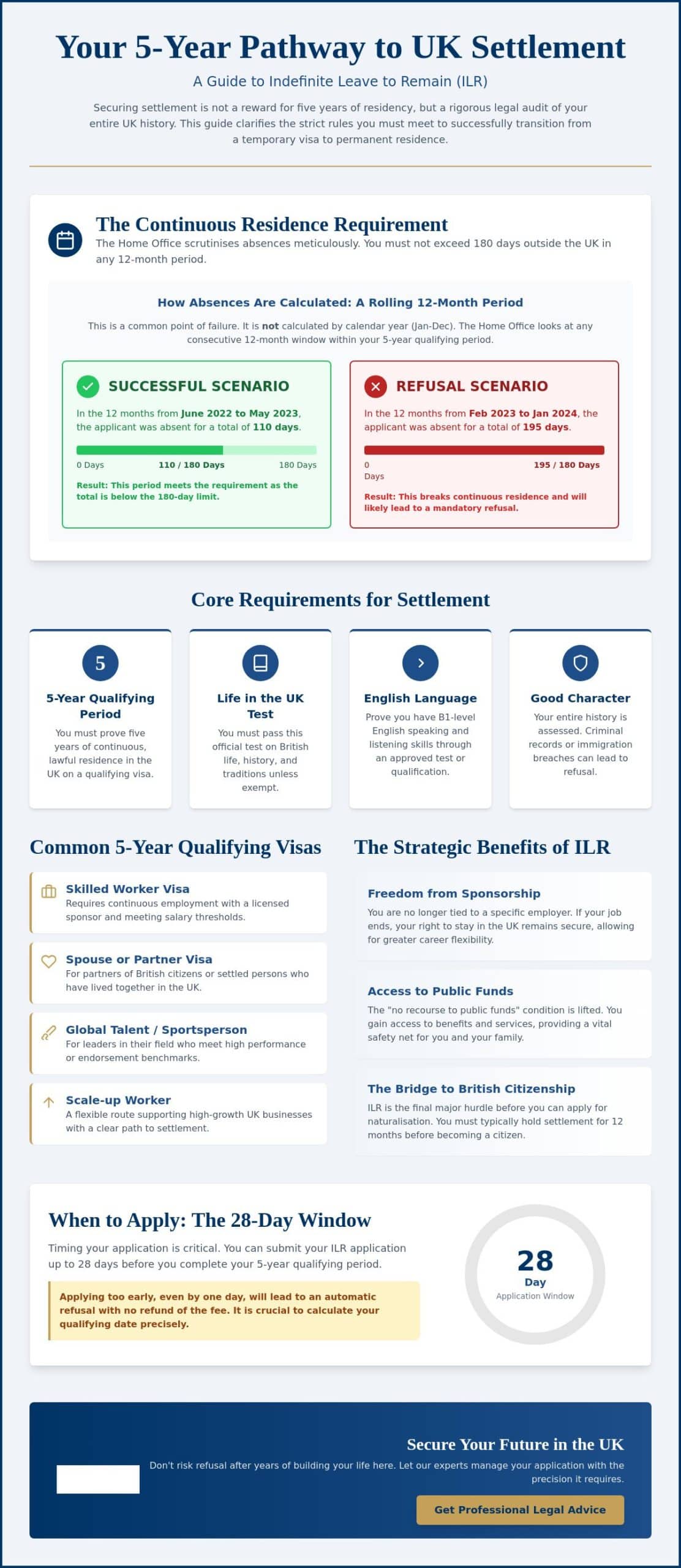
Settlement in the UK is not a reward for five years of residency. Instead, it is a rigorous legal audit of your entire history in the country. Many applicants believe reaching the five-year milestone guarantees success. However, the Home Office scrutinises every absence and financial record with extreme gravity. To apply for indefinite leave to remain after 5 years, you must treat the process as a high-stakes legal proceeding.
We understand the anxiety caused by potential refusal after years of building your life, career, and family here. This guide provides a meticulous roadmap to navigating the strict eligibility and residency rules required for UK settlement. We clarify the 180-day absence rule, financial requirements, and the Life in the UK test. This structured approach helps you secure your status and move toward British citizenship with total clarity.
Key Takeaways
- Understand how the Home Office calculates the 180-day absence limit on a rolling basis to avoid a residency-based refusal.
- Learn when to apply for indefinite leave to remain after 5 years, including the strategic use of the 28-day window.
- Identify the financial and suitability benchmarks required to transition from temporary leave to permanent settlement.
- Distinguish between SET (O) and SET (M) routes to ensure your evidence aligns with the requirements of your visa.
- Recognise common refusal risks so you can prepare for rigorous Home Office scrutiny.
Understanding the 5-Year Pathway to UK Settlement
Indefinite Leave to Remain, often called ILR or settlement, is one of the most important milestones in a migrant’s journey. It gives you permission to live and work in the UK without a time limit. Unlike temporary leave to remain, settlement does not expire in the same way and usually ends the repeated cycle of visa renewals.
The decision to apply for indefinite leave to remain after 5 years is the standard progression for many people on work-based or family-based visas. This five-year period allows the Home Office to assess your residence, financial position, compliance and overall eligibility. Settlement gives far greater stability than temporary immigration permission. If your employment, sponsorship or personal circumstances later change, your right to live in the UK is usually no longer tied to that temporary route.
Which Visas Qualify for the 5-Year Route?
Not every visa provides a direct path to settlement. The Home Office maintains specific categories that may allow applicants to apply for indefinite leave to remain after 5 years. These include:
- Skilled Worker Visa: This replaced the old Tier 2 (General) route. Applicants must normally show continued sponsorship, eligible employment and compliance with the salary and route-specific requirements.
- Spouse or Partner Visa: Partners of British citizens or settled persons may qualify after five years under the family route, provided the relationship, financial, accommodation, English language and suitability requirements are met.
- International Sportsperson: Certain elite athletes and coaches may be able to settle if they meet the relevant route requirements and continuous residence rules.
- Scale-up Worker: This route can lead to settlement if the applicant meets the specific residence, earnings and route requirements.
The Strategic Importance of Indefinite Leave to Remain
Securing ILR is a strategic step for long-term stability. Once granted, you are no longer tied to a specific employer or sponsor in the same way as a sponsored worker. If your job ends, your right to stay in the UK is usually protected by your settlement status.
ILR may also remove the “no recourse to public funds” restriction that applies to many temporary visas. This can provide an important safety net for you and your family. It is also a key step toward British citizenship. Many applicants must usually hold settlement for at least 12 months before applying for naturalisation, unless they are married to a British citizen or another exception applies.
If you require tailored advice on your specific route, you can book an appointment with our legal team to review your eligibility and prepare your case with care.
Navigating the Continuous Residence Requirement
Continuous residence is central to a successful settlement application. It is not enough to hold a valid visa for sixty months. You must show that the UK remained your main home throughout the qualifying period. The Home Office applies absence rules carefully. If you exceed the permitted absence limit, your continuous residence may be broken and your application may be refused.
The qualifying period is the five-year window relied on for settlement. According to official government guidance on ILR, your route must allow settlement and you must meet the relevant requirements. Any gaps in lawful leave can create serious problems. If you previously relied on section 3C leave while waiting for a visa decision, this may count as lawful leave, but the dates must be evidenced properly.
Calculating the 180-Day Absence Limit
The Home Office generally calculates absences on a rolling 12-month basis for many settlement routes. This is a common point of failure. You should not simply check each calendar year. Instead, you need to review every 12-month period within your qualifying residence.
To audit your absences properly, cross-reference your passport stamps, travel bookings, employer records and your own travel history. In many routes, only whole days outside the UK count. For example, if you left the UK on Monday and returned on Friday, the full days outside the UK would usually be Tuesday, Wednesday and Thursday. The exact approach can depend on the route and the applicable rules, so the calculation should be checked before submission.
Exceptions and Compassionate Circumstances
There may be limited circumstances where absences above the usual limit can be explained. These cases require strong evidence. Serious illness, travel disruption, natural disaster or circumstances outside your control may be relevant, but a general explanation is rarely enough.
If your absences are close to or above the permitted limit, you should prepare a careful legal explanation supported by objective documents. Hospital records, official travel restrictions, employer letters or other independent evidence may be needed. Without this, a caseworker may apply the rules strictly and refuse the application.
Mandatory Requirements Beyond Residency
Five years of residence is only one part of the settlement process. To apply for indefinite leave to remain after 5 years, you must also meet the relevant validity, eligibility and suitability requirements. The Home Office will consider your immigration history, conduct and compliance with previous visa conditions.
Previous breaches can create serious risks. Caseworkers may review whether you worked only as permitted, avoided public funds if restricted, maintained lawful status and provided accurate information in earlier applications. If false information or non-disclosure is identified, the Home Office may treat the case as involving deception. That can lead to refusal and may affect future applications.
The Life in the UK Test and English Language Proficiency
Most applicants aged 18 to 64 must satisfy the knowledge of language and life in the UK requirement. This usually involves passing the Life in the UK test and proving English language ability at the required level, unless an exemption applies.
Medical exemptions may be available in limited circumstances. They must be supported by appropriate evidence. Do not assume that age, stress, poor health or difficulty preparing will automatically remove the requirement. If the test or English language evidence is missing, the application may be refused.
Financial Stability and Past Compliance
Financial evidence depends on your route. A Skilled Worker applicant will normally need evidence connected to sponsorship, salary and ongoing employment. A partner route applicant will usually need to meet the family route financial requirement unless an exemption applies.
The Home Office may compare the information in your application with other records, including HMRC data where relevant. If your payslips, bank statements, tax records or previous declarations do not match, the case can attract additional scrutiny. Any discrepancy should be explained before the application is submitted.
If you are concerned about a past mistake, missing evidence, tax discrepancy or non-disclosure, you should seek advice before applying. A careful explanation may reduce risk, but it cannot guarantee success.
The ILR Application Process: A Step-by-Step Guide
The application phase requires accuracy. Selecting the correct digital form is important. Applicants on many work-based routes, including Skilled Worker, usually use SET (O). Applicants on the partner route usually use SET (M). Using the wrong form can create delay, rejection or refusal risk.
After submitting the online application, you will usually need to provide biometrics and upload supporting documents. The UK immigration system is increasingly digital, so applicants should also ensure their UKVI account and identity details are accurate. You must remain careful after submission. Travelling outside the Common Travel Area while an in-country application is pending can cause the application to be treated as withdrawn.
Timing Your Submission: The 28-Day Rule
Timing is critical. You can usually apply for indefinite leave to remain up to 28 days before completing the qualifying period. The relevant start date may depend on your route, the date your visa was granted, the date you entered the UK, and any route-specific rules.
If you apply too early, your application may be refused. If you apply after your leave expires, you may become an overstayer unless section 3C leave protects you because a valid in-time application was submitted. Before applying, check your grant letters, entry date, immigration history and any previous extensions.
Collating the Evidential Portfolio
Your evidence must be clear, consistent and organised. The documents required depend on your route. Common evidence may include your passport, proof of identity, Life in the UK test pass, English language evidence, travel history, financial documents and route-specific documents.
For Skilled Workers, sponsor evidence may be required to confirm your employment, salary, occupation code and continuing need for your role. For partner route applicants, relationship, cohabitation, financial and accommodation evidence will usually be central. Any mismatch between payslips, bank statements, employer letters or HMRC records should be addressed before submission.
Managing Risks and Securing Your Future
When you apply for indefinite leave to remain after 5 years, you submit your immigration history to detailed review. The burden is on you to prove that you meet the requirements. Small mistakes can create significant consequences, especially where evidence is missing, inconsistent or late.
Refusal risks vary by route. Some issues are strict rule-based problems, such as applying too early, exceeding absence limits or failing to provide mandatory evidence. Other issues involve judgment, such as suitability, credibility, discrepancies, previous errors or concerns about compliance. A strong application anticipates both types of risk.
Common Reasons for ILR Refusal
- Poor record-keeping: Inaccurate travel dates can conflict with Home Office border records.
- Evidential gaps: Missing financial, employment, cohabitation or sponsorship evidence can undermine eligibility.
- Applying too early: A submission made before the permitted window may be refused.
- Suitability concerns: Criminal convictions, civil penalties, immigration breaches or deception concerns can affect the application.
- Unexplained discrepancies: Differences between application forms, HMRC records, bank statements or employer letters can trigger further scrutiny.
The Value of Meticulous Legal Representation
Legal representation can help identify weaknesses before the Home Office sees them. A proper review should test your eligibility, audit your absences, check your evidence and explain any issues clearly. Where the facts are complex, a legal representations letter can provide structure, context and legal argument.
Legal advice cannot guarantee an outcome. It can, however, reduce avoidable risk. This is particularly important where you have long absences, previous refusals, tax issues, sponsor problems, relationship evidence concerns or any past mistake that may need careful explanation.
Securing Your Permanent Future in the UK
Achieving settlement is one of the most significant legal transitions you can make in the UK. It requires more than time. You need a clean, coherent and well-evidenced application that satisfies the requirements of your specific route.
When you are ready to apply for indefinite leave to remain after 5 years, professional oversight can provide reassurance and structure. We assist with ILR eligibility assessments, residence audits, document reviews and full application preparation. Complex facts should be addressed before submission, not after refusal.
Do not leave your settlement application to chance after years of building your life in the UK. You can book a professional ILR assessment today and receive advice tailored to your immigration history, evidence and risks.
Frequently Asked Questions
Can I apply for ILR exactly 5 years after my visa was granted?
You may usually submit your application up to 28 days before you reach the end of your qualifying period. The correct start date depends on your immigration route and history. If you apply too early, your application may be refused, so your grant letters, entry date and previous extensions should be checked carefully.
What happens if I spent more than 180 days outside the UK?
Exceeding the relevant absence limit can break continuous residence and may lead to refusal. Some absences may be explainable if they were caused by serious or compelling circumstances, but this depends on the route and evidence. You should prepare objective documents and a clear explanation before applying.
Do I need to pass the Life in the UK test for the 5-year route?
Most applicants aged 18 to 64 must pass the Life in the UK test and meet the English language requirement before settlement can be granted. Limited exemptions may apply, including in some medical circumstances, but they must be properly evidenced.
Can I combine different visas to reach the 5-year ILR requirement?
It depends on your immigration route. Some settlement routes allow certain types of permission to be combined, while others do not. Time spent as a Student, visitor or on another non-settlement route will not automatically count toward a five-year settlement route and may need to be considered under a different route, such as long residence.
What is the suitability requirement for settlement?
The Home Office assesses whether there are reasons to refuse your application because of your conduct, immigration history, criminality, deception or breaches of immigration conditions. If there is anything in your history that may concern a caseworker, it should be disclosed and explained carefully.
How long does it take for the Home Office to decide an ILR application?
Decision times can vary depending on the service used, the route and whether the Home Office needs further checks. You should not assume that a decision will be made by a particular date unless that service is available and confirmed. You must also avoid travel outside the Common Travel Area while an in-country application is pending, as this can cause the application to be treated as withdrawn.