
Strategic Steps for a Partner Visa UK Application: A 2026 Legal Guide
A single oversight in a partner visa UK application can result in a life-altering refusal and family separation. You likely feel the pressure of the 2026 financial thresholds and the unforgiving nature of Home Office requirements. It is a significant burden to prove your relationship’s authenticity to a caseworker who demands rigid compliance. We recognise that your application represents the foundation of your shared future in the UK.
This guide provides a strategic roadmap to mastering Appendix FM and navigating the current legal landscape. You’ll learn how to structure your evidence to meet the highest standards whilst avoiding common refusal pitfalls. By following these steps, you can submit your application with confidence and secure the stability your family deserves.
Key Takeaways
- Learn how to navigate the 2026 financial thresholds, including the £29,000 minimum income requirement, to ensure your partner visa UK application meets strict Home Office standards.
- Understand the legal distinction between “genuine” and “subsisting” relationships to build a compelling evidential narrative that satisfies caseworker scrutiny.
- Compare the strategic advantages of the spouse, unmarried partner, and fiancé routes to determine which pathway aligns with your long-term relocation goals.
- Identify the primary causes of application refusal and implement professional strategies to mitigate these risks before your file reaches the Home Office.
- Gain a structured roadmap for gathering mandatory documentation, ensuring your evidence is presented with the meticulous detail required for a successful result.
Understanding the Partner Visa UK Application Landscape
The partner visa UK application serves as the primary gateway for family reunification under Appendix FM of the Immigration Rules. This legal framework isn’t a mere administrative hurdle; it’s a rigorous test of a couple’s shared life and future intentions. To succeed, you must demonstrate that your relationship is both genuine and subsisting. The Home Office approaches these files with a default level of scepticism, meaning your evidence must be beyond reproach. A single inconsistency can lead to a refusal, resulting in prolonged family separation and significant financial loss. Understanding the broader context of UK Family Visas is essential, as it clarifies the government’s objective: ensuring that only those with a legitimate, long-term commitment are granted entry.
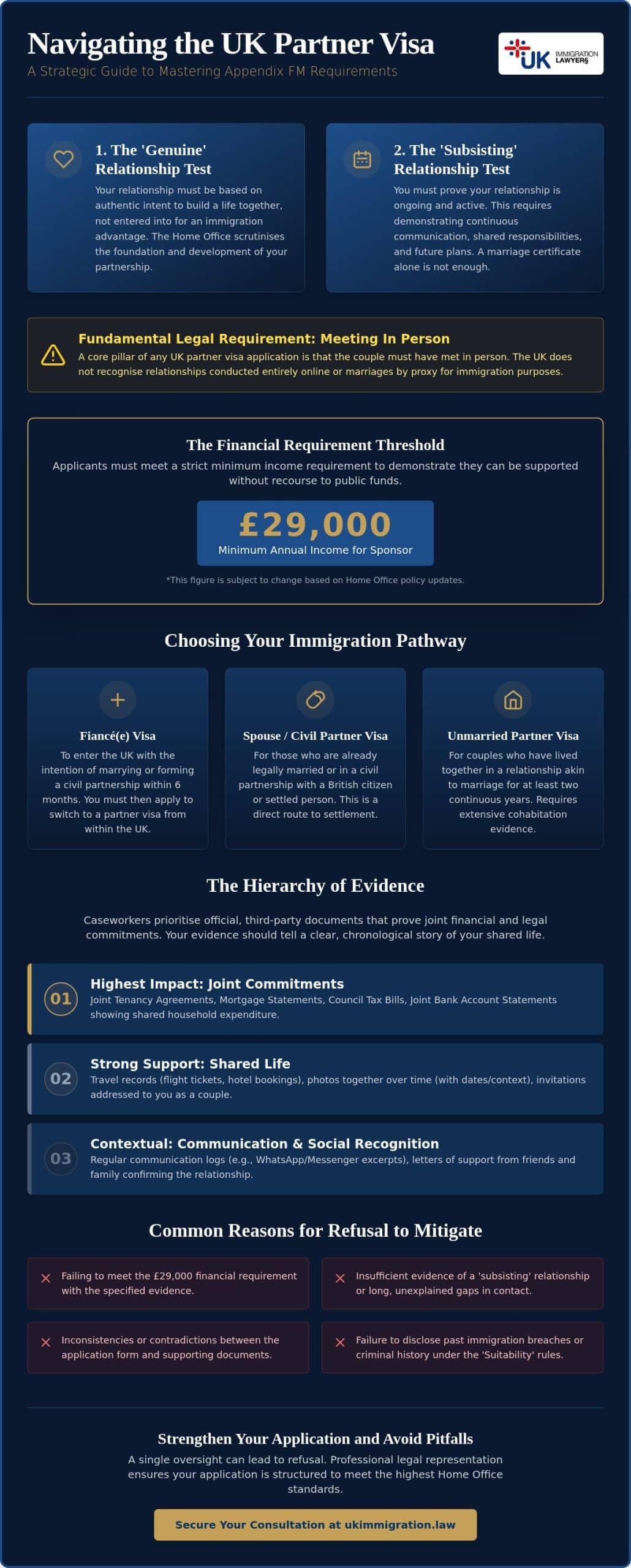
A “genuine” relationship is one based on authentic intent rather than immigration advantage. Conversely, a “subsisting” relationship is one that is currently active and thriving. You might hold a marriage certificate, but without evidence of ongoing communication or shared plans, your application remains vulnerable. The Home Office looks for a “life together,” which encompasses financial, social, and emotional ties. This evidential storytelling is what transforms a standard application into a successful one.
Who Qualifies as a Sponsoring Partner?
A sponsor acts as the legal anchor for your application. They must hold specific status, such as being a British or Irish citizen, or having Indefinite Leave to Remain (ILR). Those with settled status under the EUSS or refugee status also qualify. A critical requirement is the “intention to live together permanently” in the UK, supported by evidence of adequate accommodation that isn’t overcrowded.
The 2026 Regulatory Environment
In 2026, the Home Office maintains a policy of “compliance first,” where caseworkers scrutinise files for any reason to refuse. You must stay updated with the latest Immigration Rules, as thresholds and evidential requirements can shift. For instance, the £29,000 minimum income requirement is enforced with absolute precision. Meticulous documentation is your only defence against this rigid system.
Don’t ignore the “suitability” requirements. These rules allow the Home Office to refuse based on your past behaviour, such as immigration breaches or criminal convictions. Even a minor oversight in your history can be fatal to your case. If you have any concerns about your background or sponsor eligibility, you should book an appointment to discuss a mitigation strategy. Professional preparation is the most effective way to identify weak spots before they lead to a refusal.
The Genuine and Subsisting Relationship Requirement
The Home Office does not possess an emotional barometer to measure affection. Instead, caseworkers rely on objective data to determine if a couple satisfies the official government guidance regarding relationship validity. For a partner visa UK application to succeed, you must demonstrate that your union is both genuine and subsisting. “Genuine” refers to the authentic intent of the parties to build a life together, whilst “subsisting” denotes the current, active nature of the relationship. A fundamental legal cornerstone is the requirement to have met in person; the UK does not recognise proxy marriages or relationships conducted solely via digital platforms.
Proving love to a government official requires a shift from emotional sentiment to “evidential storytelling.” You aren’t just submitting a pile of documents. You’re constructing a chronological narrative of your life together. This process demands meticulous attention to detail, as any gap in your timeline can trigger a suspicion of “sham” arrangements. Every piece of evidence must serve a specific purpose in confirming your shared history and future commitments.
Mandatory vs. Supportive Evidence
Caseworkers operate within a strict hierarchy of evidence. They prioritise documents that demonstrate joint financial responsibility over those that merely suggest social interaction. Strong evidence includes joint mortgage statements, tenancy agreements, or shared bank accounts that show regular household transactions. Supportive evidence, such as chat logs and travel tickets, helps fill the gaps but cannot stand alone. A subsisting relationship is a continuous, active union evidenced by regular communication and shared life goals.
Handling Non-Traditional Relationship Dynamics
Many couples face challenges because they’ve never lived together due to professional obligations or cultural constraints. This does not automatically disqualify your partner visa UK application, but it does require a more strategic approach to “intervening devotion.” You must document the frequency of your visits and the consistency of your contact during periods of separation. Witness statements from objective third parties, such as family or long-term friends, can provide necessary context to your unique circumstances. If your situation involves complex cohabitation gaps, you may wish to discuss your specific evidence with a legal professional to identify potential vulnerabilities before submission. Expert management ensures that your non-traditional dynamic is explained through a lens of legal compliance rather than seen as a risk factor.
Comparing Partner Routes: Spouse, Unmarried, and Fiancé Visas
Selecting the correct pathway is a strategic decision that dictates your legal rights and evidential obligations. While all fall under the umbrella of a partner visa UK application, the entry requirements vary significantly. If you’re already married or in a civil partnership recognised in the UK, the Spouse Visa is the most direct route. It requires a valid marriage certificate and proof of a genuine union. Conversely, the Unmarried Partner route was historically more restrictive, requiring strictly documented cohabitation. Choosing the wrong route can lead to an immediate refusal, making it vital to understand the nuances of each category before you submit your file.
Spouse vs. Unmarried Partner: Which is Right for You?
The primary difference lies in the evidential burden. A Spouse Visa is anchored by a legal document, whereas an Unmarried Partner application traditionally required two years of joint utility bills or tenancy agreements. However, a significant rule change in 2024 introduced flexibility. Unmarried partners can now qualify without two years of cohabitation if they provide a compelling reason for living apart, such as work commitments or cultural restrictions. This “equivalent to marriage” standard still requires proof of a committed, long-term relationship. Understanding the financial requirement for partner visas remains essential regardless of the specific route chosen.
The Fiancé Visa Strategy
The Fiancé Visa is a tactical entry route for those intending to marry in the UK within six months. It serves as a bridge to a Spouse Visa but carries a significant limitation: you cannot work whilst on this visa. This prohibition often causes financial strain, as the applicant remains dependent on the sponsor until they switch to a Spouse Visa post-ceremony. From a cost perspective, the Fiancé route is more expensive overall. You must pay for the initial entry clearance and then pay again for the “leave to remain” application once married. If you’re already eligible to marry outside the UK, applying for a Spouse Visa directly is often the more efficient choice.
If you’re currently in the UK on a visa that allows switching, such as a Skilled Worker or Student visa, you may apply from within the country. This avoids the disruption of international travel and allows for a smoother transition. However, those on a Visitor visa cannot switch and must return to their home country to file their partner visa UK application. If you’re unsure which route offers the highest probability of success for your unique circumstances, it is advisable to book an appointment for a comprehensive case assessment. Professional guidance ensures you don’t waste time or funds on a route that doesn’t fit your profile.
Strategic Preparation: Meeting Financial and Evidential Thresholds
Meeting the financial thresholds for a partner visa UK application requires more than just earning a sufficient salary. It demands the meticulous assembly of evidence that leaves no room for caseworker interpretation. As of 2026, the minimum income requirement remains £29,000 per year. If you can’t meet this through employment, you must strategically navigate the alternative categories defined by the Home Office. The burden of proof rests entirely on you to demonstrate that your household won’t rely on public funds.
Step 1: Identify your income source. Category A applies if the sponsor has been with the same employer for at least six months. Category B is used for those with shorter tenures or variable income. Category C covers non-employment income, whilst Category D focuses on cash savings. Step 2: Calculate the required amount. If you rely solely on cash savings, you must hold £88,500 for a minimum of six months. Step 3: Organise your documentation with surgical precision. Your six months of payslips must correspond exactly with your bank statements. Any discrepancy, even by a single penny, can trigger a refusal. Step 4: Verify your English language proficiency. Initial applicants must pass an approved test at A1 level or higher.
The Financial Requirement: Beyond Simple Salaries
If your salary falls short of the £29,000 threshold, you can use Category D cash savings to bridge the gap. The formula for this is specific, as it involves offsetting the shortfall over the visa’s duration. For those who are self-employed or acting as a company director, Category F or G rules apply. These require a full financial year of evidence, including tax returns and audited accounts. You can find a detailed breakdown of these specific rules in our UK Spouse Visa: The Comprehensive Legal Guide for 2026.
The Accommodation Requirement
You must prove you have adequate housing that is not overcrowded under the Housing Act 1985. This is a common point of failure for couples living with parents or in shared flats. You’ll need to provide a tenancy agreement or land registry deeds. If you share the property with others, a property inspection report is highly recommended. This document provides independent verification that the property has sufficient rooms for all occupants. If you’re concerned about meeting these rigid evidential standards, you should book a financial document review to ensure your file is compliant. Expert scrutiny before submission is the most effective way to prevent a refusal based on technical errors.
Mitigating Refusal Risks: The Value of Specialist Legal Representation
A partner visa UK application is a high-stakes legal process where the margin for error is non-existent. The Home Office adopts a rigid approach to compliance; they do not offer opportunities to correct simple oversights after a submission is made. A refusal isn’t merely an administrative setback. It results in the loss of significant fees, a permanent record of immigration failure, and the immediate separation of your family. Understanding the primary triggers for refusal is the first step in building a resilient case.
Caseworkers typically refuse applications based on three recurring failures. First, the omission of mandatory documents specified in Appendix FM-SE, such as specific formats for bank statements or employer letters. Second, incorrect financial calculations, where the applicant misinterprets how gross annual income is assessed under different categories. Third, “non-genuine” findings, which occur when the evidence fails to present a cohesive narrative of a shared life. A legal professional acts as a strategic auditor, identifying these “weak spots” before your file reaches the Home Office. We ensure that every document serves a specific legal purpose and meets the exact evidentiary standard required.
The “Letter of Representation” is a critical component of a professionally managed file. This document, drafted by a specialist, frames your evidence within the context of current Immigration Rules and case law. It explains complex facts, such as non-traditional cohabitation or variable income, ensuring the caseworker has a clear path to approval. Professional intervention is an investment in your family’s future certainty, transforming a stressful gamble into a disciplined legal strategy.
When the Case is Complex
Certain circumstances demand a higher level of scrutiny and strategic depth. If you have a history of previous visa refusals or immigration breaches, your application faces a “presumption of non-compliance” that must be robustly rebutted. Cases involving dependent children from previous relationships add layers of complexity to both the financial and accommodation requirements. In borderline scenarios, we may employ arguments based on Article 8 of the European Convention on Human Rights (the Right to Family Life). This provides a legal safety net when rigid rules might otherwise lead to an unjust separation.
Next Steps: Securing Professional Guidance
The complexity of the 2026 immigration landscape means that “doing it yourself” carries significant risk. You should book a specialist legal consultation to assess your specific eligibility and identify any potential barriers to success. A professionally managed application provides the peace of mind that your evidence is beyond reproach. Do not leave your family’s future to chance; organise your application with expert support to ensure the highest probability of a successful outcome.
Securing Your Future Together in the UK
Success in a partner visa UK application is never the result of chance; it’s the outcome of disciplined preparation and an uncompromising adherence to Appendix FM requirements. You’ve learned that meeting the £29,000 financial threshold requires more than just sincerity. It requires a structured narrative supported by surgical precision in your documentation. Whether you’re navigating the 2024 rule changes or transitioning from a fiancé visa, you must mitigate refusal risks before submission.
Our firm operates with a specialist focus on complex family migration and maintains a high success rate in challenging Home Office refusals. As a regulated legal body, we provide the expert guidance needed to navigate this rigid system. If you’re ready to move from uncertainty to a clear, managed path, you should Book a Strategic Consultation for Your Partner Visa. We manage the complexities of your case so you can begin your future in the UK with absolute certainty.
Frequently Asked Questions
Can I apply for a UK partner visa if we have never lived together?
You can apply for a UK partner visa without having lived together if you demonstrate a relationship akin to marriage. The 2024 rule changes introduced flexibility for couples in a committed relationship for at least two years who are unable to cohabit due to work, study, or cultural constraints. You must still provide robust evidence of your shared life and a legitimate reason for living apart.
What is the minimum income requirement for a partner visa UK application in 2026?
The minimum income requirement for a partner visa UK application in 2026 is £29,000 per year. This threshold applies to the sponsor’s gross annual salary, though you can also meet the requirement through non-employment income or specific levels of cash savings. This amount does not increase if you are also sponsoring dependent children, but precise documentation is mandatory to avoid a summary refusal.
How long does a partner visa UK application take to process?
Standard processing times vary depending on where you submit your partner visa UK application. Applications made from outside the UK typically take 12 weeks to process, whilst those submitted from within the UK generally receive a decision within 8 weeks. Priority services may be available for an additional fee to expedite these timelines, though these options do not guarantee a successful outcome.
Can I switch to a partner visa from a visitor visa whilst in the UK?
You cannot switch to a partner visa from a visitor visa whilst you are in the UK. Visitors are strictly prohibited from changing their visa category from within the country under the current Immigration Rules. You must return to your home country or a country where you have residence rights to submit an entry clearance application. Attempting to apply from within the UK as a visitor will lead to an immediate refusal.
What happens if my partner visa application is refused by the Home Office?
Most partner visa refusals carry a right of appeal to the First-tier Tribunal on human rights grounds. Alternatively, you might consider an Administrative Review or a fresh application if the refusal was based on a simple evidential oversight. A legal professional can help you determine the most strategic path forward following a negative decision to protect your family’s future.
Do I need to take an English language test for a partner visa?
Most applicants must pass an approved English language test at CEFR level A1 for their initial application. You must use a provider authorised by the Home Office and ensure the certificate is valid at the time of your submission. Exemptions apply if you are from a majority English-speaking country or hold a degree taught in English that is recognised by Ecctis.
Can my children be included in my partner visa application?
You can include your children as dependants if they are under the age of 18 at the time of submission. You must demonstrate that you have sole responsibility for their upbringing or that there are compelling reasons for their entry. Although the financial threshold no longer increases per child, you must still prove that your UK accommodation is adequate for the entire family unit.
What is the difference between a spouse visa and an unmarried partner visa?
A spouse visa requires a marriage or civil partnership certificate recognised under UK law, whereas an unmarried partner visa is for couples who have lived together for at least two years or can prove a similar long-term commitment. Both routes require the same financial and English language standards. They differ only in the specific documentation used to verify the legal standing of your relationship.