
UK Spouse Visa: The Comprehensive Legal Guide for 2026
What if the only thing standing between your family’s future and a Home Office refusal is a single missing bank statement or a misunderstood financial calculation? You’ve likely spent hours scrutinising the £29,000 income requirement, feeling the weight of a system that often seems designed to keep people apart. The fear of family separation is a heavy burden, especially when the volume of required evidence feels overwhelming and the rules feel unforgiving. We understand that a spouse visa uk application is not just paperwork; it’s a strategic legal submission that determines your life together in Britain.
This guide provides the meticulous legal clarity you need to navigate the process with absolute precision and confidence. You’ll find a rigorous breakdown of the current financial thresholds, the specific documentation required to prove a genuine relationship, and the professional steps necessary to ensure a successful grant. We’ll examine the 2026 requirements and the five-year route to settlement, giving you a clear, disciplined path to securing your family’s future. If you follow this structured approach, you can replace confusion with a steady, evidence-led strategy.
Key Takeaways
- Understand the 2026 financial thresholds, including the £29,000 income requirement and the specific rules for utilising cash savings.
- Learn how to substantiate a genuine and subsisting relationship using a meticulously organised portfolio of supporting evidence.
- Navigate the step-by-step submission process for a spouse visa uk, including the nuances of digital document uploads.
- Discover how to identify potential refusal triggers and the strategic value of a formal Letter of Representation.
- Gain a clear understanding of the five-year route to settlement and the mandatory suitability requirements for all applicants.
Navigating the UK Spouse Visa Landscape in 2026
The spouse visa uk is governed by Appendix FM of the Immigration Rules; a complex legal framework designed to balance the right to family life with the state’s objective of maintaining robust border controls. To qualify, an applicant must be sponsored by a partner who is either a British citizen, a person with Indefinite Leave to Remain (ILR), or an individual with settled status under the EU Settlement Scheme. This role is not merely administrative. The sponsor acts as the legal guarantor for the applicant’s maintenance and accommodation, ensuring they will not require recourse to public funds during their stay. If the sponsor cannot meet the specific criteria set out in the rules, the application will fail regardless of the relationship’s legitimacy.
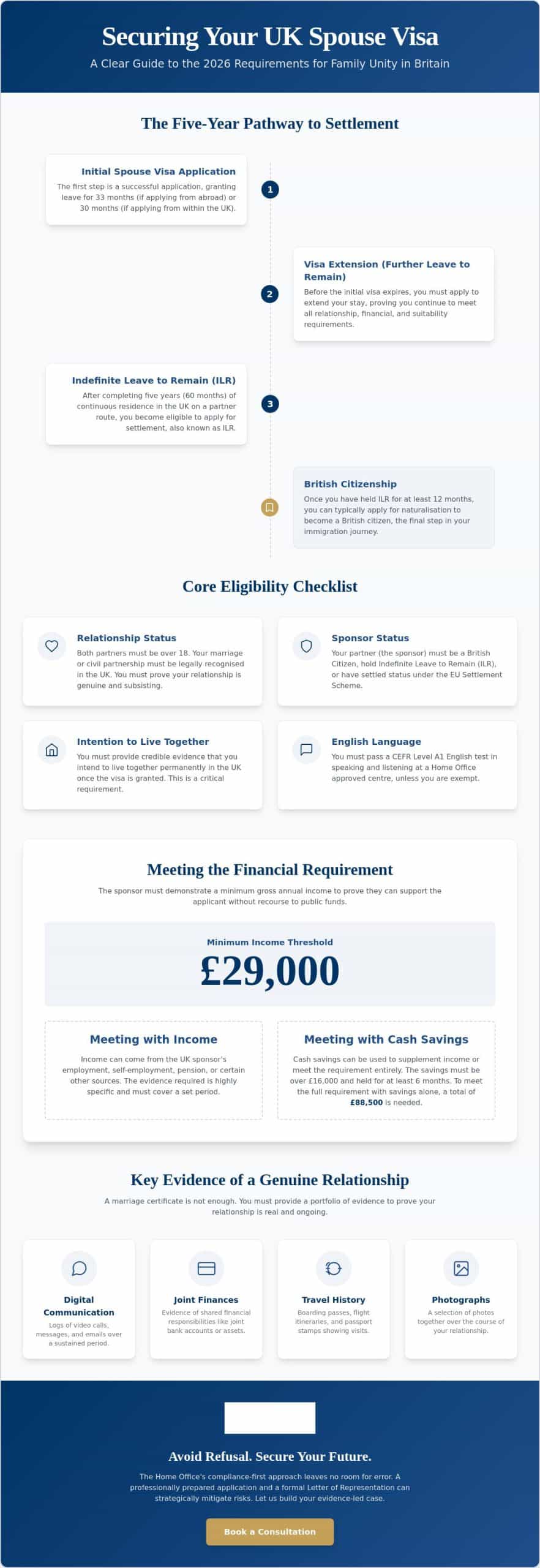
The 2026 regulatory environment represents a period of heightened scrutiny. Caseworkers now follow a rigid, checklist-driven methodology that leaves little room for explanation or discretion. A successful application typically grants an initial period of leave for 33 months if applied for from outside the UK, or 30 months if switching from within. This is the first stage of the mandatory five-year route to settlement. If the applicant maintains continuous residence and continues to meet the eligibility requirements, they can eventually apply for Indefinite Leave to Remain and, subsequently, British citizenship.
The Legal Purpose of the Family Visa
The primary objective of this route is to facilitate long-term integration and family unity. It’s vital to distinguish this from the Fiancé visa category, which is a temporary six-month entry clearance intended solely for the purpose of marriage. Whilst a fiancé cannot work or access the NHS for free, a successful spouse visa grant provides immediate and unrestricted rights to work and study in Britain. You can find a broader UK Family Visa Overview to understand how this fits into the wider immigration system. This category is designed for those who intend to make the UK their permanent home.
Why 2026 Regulations Demand Meticulous Preparation
In 2026, the Home Office operates with a compliance-first mindset. The margin for error has narrowed significantly. Whilst previous years might have seen a level of caseworker flexibility for minor omissions, current policy shifts demand absolute adherence to evidential requirements. A “near enough” submission often results in an immediate refusal rather than a request for further information. This creates a high-stakes environment where the financial loss of the application fee is compounded by the emotional distress of family separation. If you are concerned about meeting these rigid standards, you may wish to book an appointment with a specialist to review your case strategy before submission.
Core Eligibility Criteria: Relationship and Suitability Requirements
Whilst the financial threshold often dominates the conversation, the Home Office first scrutinises the legal validity of your partnership. To secure a spouse visa uk, both parties must be at least 18 years old. Your marriage or civil partnership must be recognised as legally valid in the country where it took place and under UK law. If your ceremony occurred in a jurisdiction with different legal standards, you must ensure it meets the Home Office’s specific recognition criteria. The Official Government Spouse Visa Guidance confirms that you must also prove your intention to live together permanently in Britain.
The English language requirement serves as another mandatory hurdle. Unless you are a national of a majority English-speaking country or hold a degree taught in English, you must pass a certified test. This usually requires a Speaking and Listening qualification at CEFR level A1. You must take this test at a Home Office approved provider. Failing to use an authorised centre will result in an automatic refusal of your application.
Proving a Genuine and Subsisting Relationship
A marriage certificate is merely the starting point for a caseworker. They require a chronological narrative proving your relationship is active and enduring. This is often difficult for couples who have lived apart due to work or study. In these cases, you must provide secondary evidence such as:
- Travel records and boarding passes showing visits to one another.
- Logs of digital communication and video calls over a sustained period.
- Evidence of joint financial responsibilities or shared assets.
- Photographs and social evidence that document your time together.
If you are concerned about the strength of your evidence, you may wish to arrange a professional document review to identify any gaps before submission.
Suitability and the Good Character Requirement
Suitability is frequently the most overlooked aspect of the application. It involves the “General Grounds for Refusal,” allowing the Home Office to reject candidates based on past conduct. This includes criminal convictions, previous immigration breaches, or outstanding NHS debt. Non-disclosure is often fatal. If a caseworker discovers a failure to declare a past refusal, they may refuse the visa for deception. Honesty is the only viable strategy. Any complexity in your history requires a proactive legal explanation to mitigate the risk of mandatory refusal.
Deciphering the £29,000 Financial Requirement and Maintenance Rules
Since April 2024, the minimum income threshold for a spouse visa uk has been set at £29,000 per year. This figure remains the current standard for 2026 applications. For entry clearance applications made from outside Britain, the Home Office focuses almost exclusively on the sponsor’s earnings. If the applicant is already working legally in the UK, their income can also be counted. You must provide evidence covering either a 6-month or 12-month period. This depends on whether you’ve been with your employer for more than six months. Missing a single payslip or bank statement usually leads to an immediate refusal. Detailed rules are found in the UK government spouse visa guidance, which mandates that all documents must be dated within 28 days of the application.
Permitted Sources of Income and Cash Savings
Combining income streams requires a high level of precision. You can often merge salaried employment with dividends, rental income, or non-employment sources to meet the threshold. If you’re a Director of a limited company, you must provide specified evidence for the relevant financial year. This includes CT600 forms and professionally audited accounts. If the sponsor’s income is insufficient, you can utilise cash savings over £16,000 to bridge the gap. The Home Office applies a 2.5x multiplier to the income deficit. To meet the full requirement through savings alone, you must hold £88,500 in a regulated account for at least six months.
Exemptions and the Adequate Maintenance Pathway
Sponsors receiving specific disability-related benefits or Carer’s Allowance are exempt from the £29,000 threshold. They must instead demonstrate “adequate maintenance.” This calculation subtracts weekly housing costs from net income to ensure the family has enough to live on. The remaining amount must at least equal the equivalent of Income Support for a family of your size. If you cannot meet either requirement, you must prove “exceptional circumstances.” This involves demonstrating that a refusal would result in unjustifiably harsh consequences for you or your family. This is a high legal threshold rooted in Article 8 of the ECHR. If you’re unsure which path applies, you should book a strategic consultation to assess your eligibility.
The Application Methodology: From Submission to Decision
The procedural path for a spouse visa uk depends entirely on your current location and immigration status. Overseas applicants must apply for entry clearance, which typically results in a 33-month visa. This extra three months provides a buffer for travel and initial settlement. Conversely, those already in Britain on a valid long-term visa apply to switch, receiving a 30-month grant. The digital submission of the online form marks the legal start of this process. It’s the moment your evidence is locked against the current Immigration Rules.
Processing timelines in 2026 reflect a system under significant pressure. Standard overseas applications typically take up to 12 weeks, whilst in-country decisions usually arrive within 8 weeks. Priority services can reduce these windows significantly, often providing a decision within 30 working days for overseas applicants or one working day for those using Super Priority in the UK. Speed should never compromise quality. A fast refusal is a costly mistake. Your focus must remain on the absolute accuracy of the submission to ensure a successful outcome.
Differences Between Entry Clearance and Switching Within the UK
Eligibility to switch is strictly regulated. If you hold a Student or Skilled Worker visa, you can usually transition into the Spouse category from within the UK. However, the Home Office maintains a rigid prohibition on switching from a Visitor visa. Attempting this will lead to a refusal, as the rules require you to return to your home country to apply for entry clearance. Rare exceptions exist only under exceptional human rights grounds, which carry a significantly higher burden of proof. If your situation is complex, you should book a strategic case review before submitting your application.
Document Scrutiny and the Evidence Checklist
Caseworkers review hundreds of applications. Disorganised bundles increase the risk of an oversight or a wrongful refusal. You must manage the digital upload to VFS Global or TLScontact with extreme care. Every non-English document requires a certified translation that meets specific Home Office standards. A final pre-submission audit is essential. Ensure that every mandatory field in the application form aligns perfectly with your supporting evidence. Discrepancies between the form and your bank statements or marriage certificates often trigger unnecessary scrutiny or mandatory requests for further information.
The biometric appointment is the final physical step. You must attend a visa application centre to provide your fingerprints and a digital photograph. This appointment does not involve an interview about your relationship; it’s a security and identity verification process. Once biometrics are completed, the processing clock begins. You should monitor your email closely for any requests for additional documentation, as these usually require a response within ten working days to avoid a refusal based on non-compliance.
Mitigating Risk: The Value of Strategic Legal Representation
A successful spouse visa uk application is built on more than just a genuine relationship. It requires a clinical adherence to the Home Office’s evidential standards. A specialist immigration lawyer acts as a critical filter, identifying potential “red flags” such as non-compliant bank statement formats or insufficient cohabitation evidence before the caseworker sees them. This proactive scrutiny is often the difference between a grant and a refusal. We frame your application with a formal Letter of Representation. This document serves as a legal roadmap, citing specific Immigration Rules and explaining how your evidence satisfies every mandatory requirement. It ensures the caseworker cannot easily overlook the strengths of your submission.
Self-prepared applications frequently fail on minor technicalities despite the couple being entirely legitimate. If a caseworker finds a single discrepancy in your timeline or a missing document, they are not obliged to ask for clarification. They can simply refuse. The financial cost of a new application is substantial, with fees set at £2,064 for overseas submissions and £1,407 for those made within Britain. Professional management mitigates these risks by ensuring your bundle is exhaustive and professionally organised from the outset. This disciplined approach protects your initial investment and prevents the emotional trauma of an avoidable refusal.
Common Pitfalls and Reasons for Home Office Refusal
The “specified evidence” trap remains the most common cause of failure. The Home Office mandates that financial documents must be provided in a very specific format. If you submit a digital bank statement that hasn’t been properly authenticated or is missing a single page, your application will likely be rejected. Inconsistencies in your relationship narrative also trigger scrutiny. If your application form contradicts the dates provided in your support letters, the caseworker may question the “genuine and subsisting” nature of your partnership. The cost of reapplying often far exceeds the initial investment in professional management, especially when considering the loss of the Immigration Health Surcharge and the delay to your life together.
How Professional Management Secures Your Future
Strategic legal advice is particularly vital for complex cases involving previous visa refusals or non-standard income structures. If you’ve been refused before, your next application must address those previous concerns with absolute precision. We help you maintain a meticulous record that will be essential for your eventual Indefinite Leave to Remain (ILR) and British Citizenship applications. Getting the first stage of the five-year route right sets the foundation for your entire future in the UK. You can secure your family’s future with a professional spouse visa consultation to ensure your case is managed with the gravity it deserves.
Securing Your Family’s Permanent Future in Britain
The 2026 regulatory landscape requires a strategic and disciplined approach to evidence. You’ve seen how the £29,000 threshold and relationship criteria form the backbone of a successful spouse visa uk. Technical refusal risks are significantly reduced by meticulously organised documentation. If you frame your legal argument correctly, you can manage the Home Office methodology with confidence. A successful grant is the first step toward a permanent life in Britain. It’s the foundation of your family’s long-term security.
Our firm maintains regulation under the highest UK legal standards and a high success rate in family migration matters. Expertise in complex Appendix FM appeals allows us to provide a protective shield for our clients. You don’t have to face this complex process alone. Book a specialist legal consultation for your UK Spouse Visa application today. We handle every case with the gravity it deserves. Helping you build your future together in the UK is our priority.
Frequently Asked Questions
How much is the UK Spouse Visa fee in 2026?
As of 8 April 2026, the Home Office fee for a partner or spouse visa application made outside the UK is £2,064. The fee for an application to extend or switch from inside the UK is £1,407. You may also need to pay the Immigration Health Surcharge, which is usually calculated by the length of permission granted. Check the current GOV.UK family visa page before paying, because fees and surcharge figures can change.
Can I use my own income to meet the financial requirement if I am the applicant?
It depends on where you are applying from and what immigration permission you currently hold. If you are already lawfully in the UK with permission to work, your income may be counted with your partner’s income, provided the specified evidence rules are met. If you are applying from outside the UK, your overseas employment income is usually not counted in the same way, although savings and other permitted sources may be relevant. This point should be checked carefully before relying on income evidence.
What happens if my UK Spouse Visa is refused?
A spouse or partner visa refusal often carries a right of appeal on human rights grounds, but the best next step depends on the refusal reason. Sometimes an appeal is needed because the Home Office has misunderstood the evidence or applied the Rules unfairly. In other cases, a fresh application with stronger evidence may be more practical. Do not assume that reapplying is safer until the refusal letter, missing documents and appeal deadline have been reviewed.
How long does the UK Spouse Visa take to process in 2026?
GOV.UK states that a partner or spouse visa application made outside the UK usually receives a decision within 12 weeks. An in-country application that meets the financial and English language requirements is usually decided within 8 weeks. A case may take longer if it is complex, evidence needs to be checked, suitability issues arise or the Home Office treats it as non-straightforward. Faster paid services may be available, but they do not guarantee approval.
Can I work in the UK on a Spouse Visa?
Yes. If your spouse or partner visa is granted, you can usually work and study in the UK without needing a separate work visa or employer sponsor. This is different from a fiancé, fiancée or proposed civil partner visa, where work and study are not normally permitted before switching into the partner route after marriage or civil partnership.
Is there a way to avoid the £29,000 income requirement?
There is no simple loophole. The fixed £29,000 minimum income requirement does not apply in the same way if the sponsoring partner receives certain disability or carer’s benefits, but the applicant must still show adequate maintenance and accommodation. Where the financial requirement is not met, a case may still succeed on human rights grounds only if the evidence shows that refusal would cause consequences serious enough under the Immigration Rules and Article 8 principles.
Do I need to take an English test if I have a degree from overseas?
You may not need a Secure English Language Test if your overseas degree was taught in English and Ecctis confirms that it is equivalent to a UK bachelor’s degree or higher and was taught in English. If that evidence is not available or does not meet the required standard, you will usually need to pass an approved English language test. For a first partner visa, the required level is at least CEFR A1 in speaking and listening.
What is the difference between a Spouse Visa and a Partner Visa?
A spouse visa is for a person who is legally married to a British or settled partner, or to another qualifying partner under the family route. A partner visa can also cover civil partners, proposed civil partners, fiancé(e)s and unmarried partners. Unmarried partners no longer have to prove two years of cohabitation in every case, but they must prove a genuine and subsisting relationship similar to marriage or civil partnership, with strong evidence explaining any period spent living apart.
This FAQ is general information about the UK spouse and partner visa route. It is not legal advice on your individual facts. Fees, evidence rules, service availability and Home Office practice can change, so the position should be checked before an application is submitted.
Last legally reviewed: 25 June 2026
By: Adam Sierant